
True Gaming Do you enjoy difficult/grindy games? |
- Do you enjoy difficult/grindy games?
- Mechanics of grinding and how they retain a player's attention vs. fresh content.
- The Impact of Voice Acting in Video Games
- [Spoilers] Apollo Justice: Ace Attorney. A good , but flawed game experience, with interesting writing and ambitious ideas. A potential wasted in the saga
- Fortnite teammates.
- Games that handle weather immersively without being annoying?
- Playing through Jedi Knight II: Jedi Outcast again for the time in almost 10 years and I think I hate this game. So why can't I stop playing it?
- Star Fox 64, A Literal Casual Filter, Meaningful Choices, and The Cinematic Experience
- As opposed to violence, what COULD we theoretically learn from video games?
- Let's Take a Moment to Appreciate How Smart Dunkey Is
- The issue of historical accuracy and authenticity in video games
| Do you enjoy difficult/grindy games? Posted: 08 Apr 2018 09:53 AM PDT I was thinking about it lately - do you guys enjoy difficult games that put your patience to the test? I'm talking about titles like Dark Souls or games where you need to grind specific boss 20, 30 times (oldschool WoW, Grim Dawn) to get just one piece of loot. I used to play this kind of games (Dark Souls, Grim Dawn) and one day I just realized that doesn't entertain me, it actually frustrates me. It wasn't entertainment, it was more like a job ("I need to finish this ******thing!!!"). What do people like in these titles, feeling of accomplishment? [link] [comments]  |
| Mechanics of grinding and how they retain a player's attention vs. fresh content. Posted: 08 Apr 2018 12:15 PM PDT I've been trying to get my friend into Destiny 1 and Monster Hunter, but he expressed that just doesn't see the appeal of grinding. This is the text I sent him attempting to lay out the basic fundamentals behind the design of a grind: " Grinding games are typically loot-based, meaning that each weapon/drop has the potential to fundamentally change the way you play. The repeated boss fights/activities are not just to get more gear, but because you learn them like the back of your hand, it allows you to become extremely inventive and creative in your playstyle. Grinds will always let players have a Grail they're chasing, their carrot on a stick. However, good grinds are ones where the sandbox is fun enough to warrant playing without the external reward, items and builds are player-set goals and self expression within the grind sandbox. Grind games typically have extreme mechanical depth, allowing every encounter to played in an infinite amount of ways. Players are expected to change their builds and play styles consistently to match the challenges a) Intrinsically have more fun b) Have a better chance of beating the encounter and receiving your reward c)The hell of trying something new This creates a positive feedback loop of getting better at the game>enjoying the game more fully. It's important to note, most grinders are MMORPGs at heart, and as such, are designed with a power fantasty and power curve in mind. Begin the boring basic rat, end with the dimension shattering God. Good grinds keep all enemies and activies relevant to an end-game player. (Monster Hunter gets a special note and does this by having High Rank, where once the player has defeated all the monsters they are all powered up to an equal level. It's kind of ingenius in it's simplicity. No other game does this.) The appeal of grinders is the fact you are able to replay the same activies infinitely, and good grinders will have a diverse pool to choose from, always allowing the player to keep it fresh. I feel Monster Hunter and Destiny excel in all these things. Not everyone enjoys grinding, of course, but the repeated content (diverse enough to keep interest) is the main appeal. So I find it strange you seem to not enjoy it at all. " What are your thoughts? Did I miss something essential to a grind? Do you think this theory holds any water, or should we move away from grind-based games? [link] [comments]  |
| The Impact of Voice Acting in Video Games Posted: 07 Apr 2018 08:15 PM PDT I for one, will be the first person to talk to you about a game's core mechanics and how well they fit the controls or overall gameplay. I will talk all day about the aesthetics that the game elicits for me as a player, or about how well the game grabbed me in terms of immersion. And while I will find myself sometimes mentioning a game's amazing soundtrack or art style, I rarely ever mention (good or bad) the quality of voice acting in a game. Often times I find myself so into a game, but the voice that expresses the character I am so invested in seems like a distant noise in the back of my head. The only times I ever seem to notice much of anything is if I recognize the voice actor from a different game. Very few times have I really sat down and thought, "Wow, that was some incredible voice acting." Rarely does the voice acting in a game raise or lower my overall rating of said game, and I can't tell if that is a good or bad thing. I am sure that there are many people who have a much keener ear than me, and are more affected by voice acting in games than I am. What I mainly want to discuss is this point. How impactful is voice acting to a player overall, and can we consider voice acting "good" if it doesn't affect the player or the playthrough at all? Just want to know your two cents. [link] [comments]  |
| Posted: 07 Apr 2018 07:26 PM PDT Hello, I wanted to talk about Apollo Justice after having completed it for the second time. It is one of my favorites in the franchise, but I think it's worth analyzing it more thoroughly, and talking about several aspects. So let's go with this analysis from the introduction of the game until the end of its history development. The game is a graphic adventure / visual novel that consists of 4 cases to develop the argument. This installment is the fourth title of the Ace Attorney franchise, but in its own way, this is the point of division between triology and 3DS games. Something that differentiates this game from the rest of the franchise, is the atmosphere and tone it presents, which makes it unique in a certain way: The game has a certain dark aesthetic in the scenarios, and the characters live that tone. The game wants to talk about the dark era of the law: With things like falsification of evidence, corruption and the mafia as the background of cases. The game is right in some of the aspects to work in this field: The first case is successful in everything to develop and build the stage from the first point. As the protagonist of previous deliveries becomes nothing more than a lawyer stripped of his badge and is blamed for murder as our first client, how the previous concept of the figure of the defense lawyer is deconstructed, and becomes a villain (Kristoph Gavin), the fact that our mentor, who gives us first impressions that will be a supporting character in the game, is revealed as a murderer, and we must confront him, as our client falsified evidence to have a verdict of no culpability. There is also the aspect that none of your clients is totally innocent, even, having crimes and past history that makes you question the aspect of their innocence (As a suspect Ganster, or Phoenix forging evidence at the beginning)... That separates Apollo Justice from the other games, from the familiar aspect and with caricature touches, to a more cold and sinister one. Phoenix's transition from lawyer to father, and the role he plays in the story, makes it clear. Phoenix is a forger, who developed a complicated scheme of revenge against Kristoph to put the balance of the legal system in his favor. The mystery surrounding Phoenix's past in the first and last case is fascinating, and Kristoph Gavin makes him really great as a villain. Then come case 2, which is more to introduce and characterize the characters, as the introduction and dynamic with the prosecutor with the defense attorney, the introduction of Trucy Wrigth, involve Apollo in his first case as an employee of a private agency , talk more about the past of Phoenix, re-introduce Emma Skye in the fourth installment as the main detective, and introduce you to the mechanics and dynamics of the gameplay (Interrogation, investigation, present evidence, explain more about the ability to perceive the witness's concerns and elements of detective investigation, such as the fingerprints system). At the moment I will not talk about case 3, but speaking about case 4, it has great things. Finally it reveals the master mind that is Kristoph Gavin, as a manipulative murderer, which was behind the death of Zak G., and which personality surrounds it a sinister aura and hidden mystery of Psycho black padlocks that hide the evil being behind of the lenses. The case links all the cases so that the whole game feels connected to each other, and the game has an end where it tries to transmit us, how the law is hollow and full of contradictions, and the system changes over the years , with us changing around the system. Also, how the introduction tells us and explains about certain past mysteries, and even those of which we do not realize. And when the characters look at the screen, and the player represents the jury system to make the final decision, wow. Now, what is what makes AJ "flawed"?. To begin with, speaking of the protagonist, I must assume that he is a great character: Something optimistic but sarcastic, how he genuinely wants to be a lawyer for justice and not for a tragic background, his reactions to the interactions with the other characters, having a more critical personality with regard to, and how It differs from the other main characters in the series with its way of being. At the first moment that he acts in court, you feel that after 7 years, he finally arrives at a court, where the law has been almost devastated, and he is the hope that the judicial system needed at that moment to find the truth. And he does ... for 2 cases. In the first case, you feel very close to the hand of Phoenix and his mentor, but it is not necessarily a bad thing, because due to how the story unfolds, it makes a lot of sense. The problem is in the last case: As a whole, it does not seem that Apollo's actions really mattered, or at least, you do not feel that in any way, we are as important as Phoenix is, and the story and outcome will only focus on the fall and rise of Phoenix Wright. Which is not bad in one part, on the other hand, it is a pity that Apollo did not have the opportunity to really shine in the revelation or central development of the great mystery, taking away the focus of what could be, a great execution for him to play the role he was made from the beginning. Also, case 3 would be specifically, which is the part of the development of the story where the game becomes a heavy experience. One of the main mechanics that involves one of the pieces of key evidence is exploited but in a horrible way that makes it a tedious and irritating experience to play (the videotape), the logic of the accusation is extremely questionable, the villain is weak, the prosecutor in charge of the case supports the defense more than his best friend being accused of a crime, the pace of the case is bad, and the case in general is very flat, uninteresting and full of inconsistent and dull moments. The last case even has its flaws. Like the fact that it closes other mysteries, but not its own...not at all. As the antagonist's dark psycho-locks, for example, or a certain part of the antagonist's motivations and origins, although some aspects give him the charming mysterious touch that the antagonist possesses, and you can even speculate and form an idea around the information in some points, but there are other issues that involve the plot and that intrigues long term in an unsatisfactory way. But I must admit that, although the game has its great points and amazing qualities and details that it has, it also has those flaws. And it's a shame, because the total idea of Apollo Justice, makes it have a lot of potential. Starting with the second case, where to start ?. The case in general is very good and enjoyable, but it could be amazing and unforgettable: The whole thing of the mafia as part of the background, could be a fundamental part of the development of the argument, as the Kitaki family bribes or threatens members of the court and the police to falsify or create false evidence, or even change key parts of the story: Make Wocky a secondary character to the story, make the father the murder suspect, make Alita Tiala the accused and make Plum a witness . They could develop more the characters that make up the Kitaki family, and even give a more powerful meaning to the subject related to Bigs Wins and their interest in leaving the world of crime by the condition of Wocky, and that he and Plum have a emotional confrontation in court. Eldoon is a nice, unique and particularly memorable character. It's good, but it could be MUCH better. Explore more the character as a doctor than as a noodle vendor, delve into his background story, and give a satisfactory conclusion to his little sub story. That would have benefited the case, and even, why not, would have added an important character to the franchise in the long term. And going with Case 3, the concept of the case in a concert is great, but the case as a whole makes it terrible in terms of execution. The argument could be improved if: Making the victim our client would make more sense to the accusation arguments against the accused, make the antagonist more interesting and better written, make Klavier worry more about his partner to the point of facing to the court in an emotional way, since in itself, it seems that he cared more about the guitar case than his friend, and make Laminoir a more interesting witness. In addition to that, of course, remove or make less redundant the mechanics of the video tape. They could make something much better and more digestible as part of the story and as a case. Case 4 can improve on a lot of things and be even brighter if it is composed and elaborated better: Kirstoph Gavin is great, but with an excessively paranoid direction and without adequate enough development. We seek to be complex, and the Apollo Justice message is genuinely interesting and involves something deeper than we think, but MUCH more is missing to concretize those ideas. The motives of Kristoph could be an exploit minds, since in general the saga has given us villains with more concrete and exact motivations, but this time, it becomes the main dish of the great mystery that awaits to be discovered to find that message, but the fact that the only thing we have is "I kill a man for a game of cards and because I am bad" when there is supposed to be much more than just that around him. It has all the elements, the pieces, the moment, but in the end, it is a bit disappointing and lacks substance in its moment of brilliance. As well as, well, the mysteries that it leaves aside: Not only related to Kristoph, the drawings of Adrew of the previous cases also do not lead to anything really, and the fact that Laminour is the mother of Trucy and Apollo is only revealed to the final and it means absolutely nothing because the game is over. As well as the fact that the victim was killed by the poison at the exact moment in which there was a witness in front with a sickly perfect synchronization. And well, the list goes on and on. In conclusion, I can say that Apollo Justice is a good game, or well, at least a solid one. The characters are really very good and memorable, 3 of the cases have a great mystery, the atmosphere and tone is part of what makes it special, I really like the protagonist and the research in general is good enough for a game of the saga. It could be said that it is one of my favorites. But nevertheless, that does not stop him from being far from being the best. Anyway, is next to those games like Crash Twinsanity: Those games whose concepts and ideas gave for more in their games for different reasons. It just feels rushed. The game has ambition, has vision, the context surprises me and fascinates me to take into account as a game of the series, when the game hits its positive points it is magnificent, and to this day, I do not see any other game that is feel particularly like this in the franchise to which it belongs. But, in execution stumble in certain points and it is necessary to develop all those ideas, and build them properly. And it's a shame, because even though Spirit Of Justice looks great (I have not played it), you can appreciate Takumi's attempt to end the Phoenix moment in Ace Attorney and start a new world, a new setting and a new story. Dual Destinies is the opposite of the fourth game, being more charming, bombastic, and with the colorful and friendly environment of the triology, and from here, is what makes this delivery is maintained by what makes it unique. I like it, I can even say that I love it, but it could be the best, it really could , and is very distant from being. [link] [comments]  |
| Posted: 08 Apr 2018 11:54 AM PDT I'd love to find some ADULTS to play fortnite with on the Xbox. I keep ending up on teams with 10 year olds and they won't shutup! Lol. I'm an average player. Maybe a little above. [link] [comments]  |
| Games that handle weather immersively without being annoying? Posted: 07 Apr 2018 06:17 PM PDT I cannot think of any games that handle weather immersively without being very annoying. Most games with weather effects have it only alter visuals. Some rain or snow. Of the few that have it have any impact it's only negative -- snow slows you down. Are there any games where weather has a meaningful impact on the game in an interesting or immersive way? [link] [comments]  |
| Posted: 04 Apr 2018 09:11 AM PDT I mean, I've been stuck inside a fucking reactor for hours. My last objective was literally just "navigate the intricate reactor interior". Even on 'Easy', which I selected because I wanted a calm trip down nostalgia lane, i constantly find myself in situations where enemies are one-shotting me from nests hundreds of yards away. I suppose the Dark Forces/Jedi Knight series has always been about familiarizing yourself with a specific industrial aspect of the Empire's galaxy-wide control. Finding your way through immense garbage systems, or double-backing your way through conveyor-style assembly buildings has been a staple, but in JKII I have to say it feels a bit extreme. It struck me that given they're replicating real places like docking stations, there would be public signage. The game is completely lacking in any kind of signs, labeling of areas, etc. There is no map, so you are forced to construct this foreign machination in your mind and try and guess where the Empire would put a control room. Oh, on the other side of the compound, through a door that doesn't look like a door? Great, thanks Imperial interior designer. (Imperior Designer?) BUT, man, I keep loading it back up. I'm feeling the same frustration I felt the first time around, but there is a distantly stored playthrough in my mind which is helping me out somewhat. Also the lightsaber and force mechanics just make it all worthwhile. Walking into a room and pushing 3 stormtroopers to the ground at once, or blocking their shots with your lightsaber while pulling their weapons from their hands, leaving them terrified and surrendering. It's fun every time, and I suppose it's those mechanics which bring me back. [link] [comments]  |
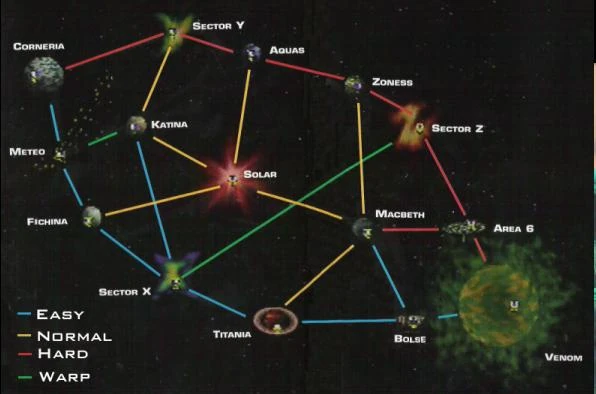
| Star Fox 64, A Literal Casual Filter, Meaningful Choices, and The Cinematic Experience Posted: 03 Apr 2018 01:29 PM PDT Over the last couple of decades there have been multiple games that have tried to capture the essence of watching a movie when playing a game. I'd like to shine some light on a game that I feel captures that feeling, while at the same time providing engaging game play that goes beyond choose-your-own adventure mechanics and same-story-different-dialogue payoffs. A game where how you play can significantly change your journey. A 21 year-old game called Starfox 64.
With some basic points out of the way, I'd like to call attention to the world map of the game, a map I affectionately call The Casual Filter. Each stage is completely unique with it's own assets, dialogue, and challenges. Starting from Corneria, the player has two victory conditions. One for skilled players, and one for those good enough to survive, but not good enough to meet the 'hard path' victory condition. This multiple win condition pattern repeats itself through the game, allowing the player to claw their way to the top from the near bottom as late as Sector-X or fall back to the easy path if the hard path is just too much to handle. It is an ingenious piece of game design that rewards skill and offers accessibility, albeit flawed as many would agree that 'easy' stages like Titania are much harder than some of the Medium stages. There are so many variables in this game and character interactions that only take place if you visit certain planets or save certain characters that you can play through the game a dozen times and not have the experience be the same. At the same time, it differs from rogue-lites like Faster Than Light and Binding of Isaac by having a more coherent plot and no randomly generated content. It is a perfect storm of digestible, varied yet predictable game play, and I feel it is a shame that we have not seen much like it 20 years after. The game may very well have been a product of it's time. The expectations the players have on graphics in this day and age just don't line up with the time it takes to produce such graphics. Star Fox 64 was visually quite simplistic, even for it's time, and I just don't think developers these days have the heart to create 8 unique stages with unique assets that may never get used. Still. I think it is perhaps the game that merges the feeling of a movie-like story with solid game play where skill and decision making matters greatly to the experience. I'd love to hear your thoughts about the systems and other games that may have used similar structures. [link] [comments]  |
| As opposed to violence, what COULD we theoretically learn from video games? Posted: 04 Apr 2018 02:03 PM PDT I've always said that Halo: Combat Evolved broadened my vocabulary far past most in my peer group. In other cases, games like ARMA have given me insight into cartography and navigation. Are there more I missed? [link] [comments]  |
| Let's Take a Moment to Appreciate How Smart Dunkey Is Posted: 05 Apr 2018 05:47 AM PDT Amidst the memes. perhaps overwhelming character. and silly for-fun gameplay videos of newer titles, I truly do feel that with or without that, Dunkey is still one of the best gaming related content creators out there, making surprisingly thought provoking videos. Even if people know this already, I can't help but feel the want to share my love for his ability to create strong, concise videos. The ones I will always come back to are his videos on Cuphead, Sonic Mania, and Ocarina of Time, his review to be specific. Between his ability to tell stories accentuating the empirical aspects of the game, like in his Cuphead and Sonic Mania videos, and his ability to meticulously craft a phrase into perfectly describing a game's aesthetic beauty like in Ocarina of Time, it's easy to forget how strong of a writer Dunkey is. Paired with his editing skills to manipulate clips in a concise, comical, and meaningful way, I feel he really proves a long time tenant of writing that shorter, trimmed down, quality writing is the reigning king. Especially where the diaspora on gaming is occasionally leading towards bloated, hour+ long exposes on why a game is overrated, or what have you. Dunkey proves his watchability thanks to his sub-ten-minutes bursts of genius. Of course, watch this videos again even if you have seen them already. My words can only do so much to demonstrate. What are some of your favorite Dunkey videos where he gets straight to the point? Edit: a word [link] [comments]  |
| The issue of historical accuracy and authenticity in video games Posted: 03 Apr 2018 06:56 AM PDT I want to share this video in light of the Kingdom Come: Deliverance controversy because of the whole historical accuracy thing. Being a history enthusiast myself, I do agree that making a historical period accurate is incredibly hard. There are so many things that the developers have to take care of, countless factors that are not influenced in the time period in a direct manner and for that, the game will take forever to develop and will risk to appear as somewhat boring or uninteresting as some people have called Kingdom Come Deliverance as that becuase of the developers' goal to make it historically accurate. So because of that, developers try to make their historical games as authentic as possible while still able to appeal to as many people as possible. This is a bit jarring to me because in the video, there are lots of dislikes which I find it confusing because I do agree with the video that making a game historically accurate is hard so authenticity is often taken into account. The problem with this is that how can define a historical game authentic? Maybe there were little black people around in Bohemia in early 15th Century (I cannot say much because despite I am a fan of history, medieval history never really appealed to me) but does it make it historically authentic to not have any people of colour appear in the game? Same thing that I have with other games which take place in historical settings such as COD WW2 has a female soldiers - it is authentic in some areas because female soldiers did exist in the case of the French resistance, the Polish resistance and the Russians, but there were never any female soldiers fighting in the front lines in the Allies side of the war (no British or American female soldiers) Or another game does not goes in a shady line of authenticity is the Assassin's Creed franchise and the Total War series. I play those games because they often portray historical settings as accurate as possible but they of course alter historical settings in certain ways such as Pope Alexander VI was indeed a very controversial pope and fathered many children and Cesare Borgia was ruthless but there is little evidence to show that he had incest with his sister. Honestly, the whole topic regarding historical authenticity is a very controversial subject where there is a shady and murky where one can define a historical setting as authentic or non-authentic despite the creative liberties that developers have in order to make their games as appealing as possible [link] [comments]  |
| You are subscribed to email updates from For those who like talking about games as much as playing them.. To stop receiving these emails, you may unsubscribe now. | Email delivery powered by Google |
| Google, 1600 Amphitheatre Parkway, Mountain View, CA 94043, United States | |
Post a Comment